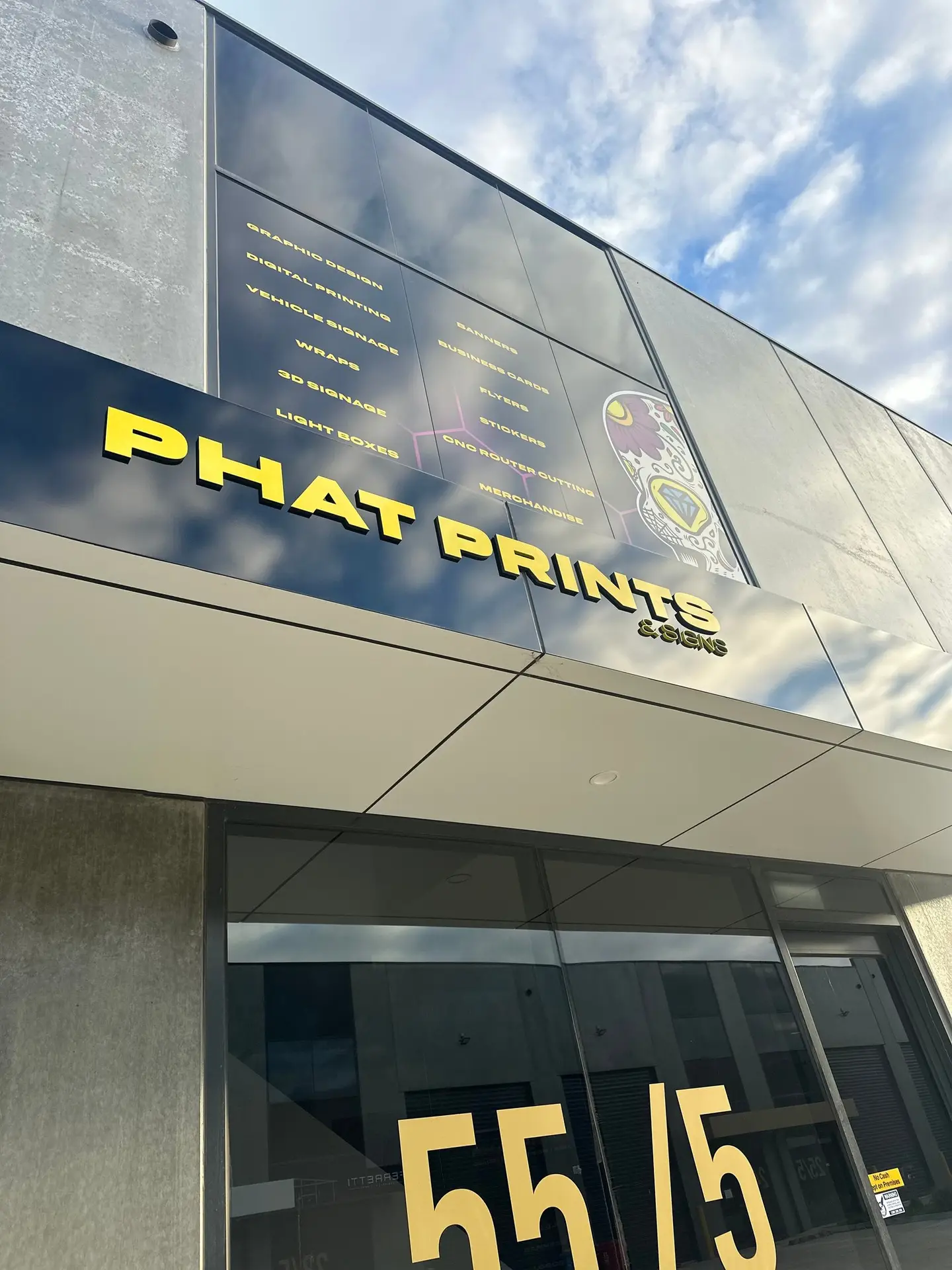

A sign can be beautifully designed and still miss its mark if the site was an afterthought. For custom outdoor signs, start with the location: exposure to sun, rain and wind, viewing distance, and the sign’s purpose all shape the result. A strong brand presence comes from practical choices as well as good artwork.
To choose a suitable material and finish, first consider where the sign will sit and what people need to read. The design should be easy to see, fit its surroundings and present your brand clearly.
This guide explains how to plan around placement, purpose and viewing distance, then consider materials and finishes for Australian conditions. You’ll also see how PHAT Prints takes business signage from concept through production and installation where required. Use the steps below to build a clear project brief and create a distinctive presence for your Victorian business.
Key Takeaways
- Start with the sign’s exact location, purpose and viewing direction so it’s designed to be seen and understood.
- Plan custom outdoor signs around local exposure to sun, rain and wind, and consider how material, finish and installation affect performance.
- Compare fascia, freestanding, banner and illuminated formats by site fit, visibility and practical requirements.
- Prepare site photos, approximate dimensions and brand artwork to create a clearer, more useful project brief.
- PHAT Prints takes business signage from concept through production and installation where required.
Custom outdoor signs start with the site, not the artwork
Custom outdoor signs are business signs designed for a specific location, audience and purpose. Begin the brief with where the sign will go and what people need to understand, not just the logo or colour palette. A sign facing a busy road has a different job from one guiding customers from a car park to an entrance.
Outdoor advertising includes everything from billboards to smaller displays, as outlined in this Outdoor Advertising Overview. For a business sign, the same principle applies: make the message visible and useful in its real setting. Match the design and specification to the site and purpose.
What should an outdoor business sign achieve?
Set one primary goal for each sign. Identification helps people recognise a business at its premises, such as a name displayed above a shopfront. Promotion puts an offer or service in view, while wayfinding directs visitors towards a driveway, reception or customer entrance.
Next, consider how people will see it. Viewing distance affects how much text and detail they can read; approach direction determines when the sign comes into view. Nearby signs, trees, parked vehicles and busy façades can compete for attention. Keep the message focused and make the most important information prominent. A sign may identify a building well but do little to guide people through a larger site, so different locations may need different sign roles.
Which site details shape the brief?
Record the position and orientation, mounting surface, approximate dimensions and anything that could block the view. Note whether people approach on foot or by vehicle, and from which direction. Photos taken from likely viewing points help turn these observations into a practical brief.
Exposure matters too. A sign in direct sun faces different conditions from one under an awning; an open location may experience more wind and rain than a sheltered position. These factors can influence design, materials, finish and mounting. Performance depends on the complete specification and how the sign is made and installed.
For a Victorian site, assess the specific position rather than assuming one regional climate tells the whole story. A shaded entrance, exposed roadside position and sheltered loading area can each present different conditions, even at the same business.
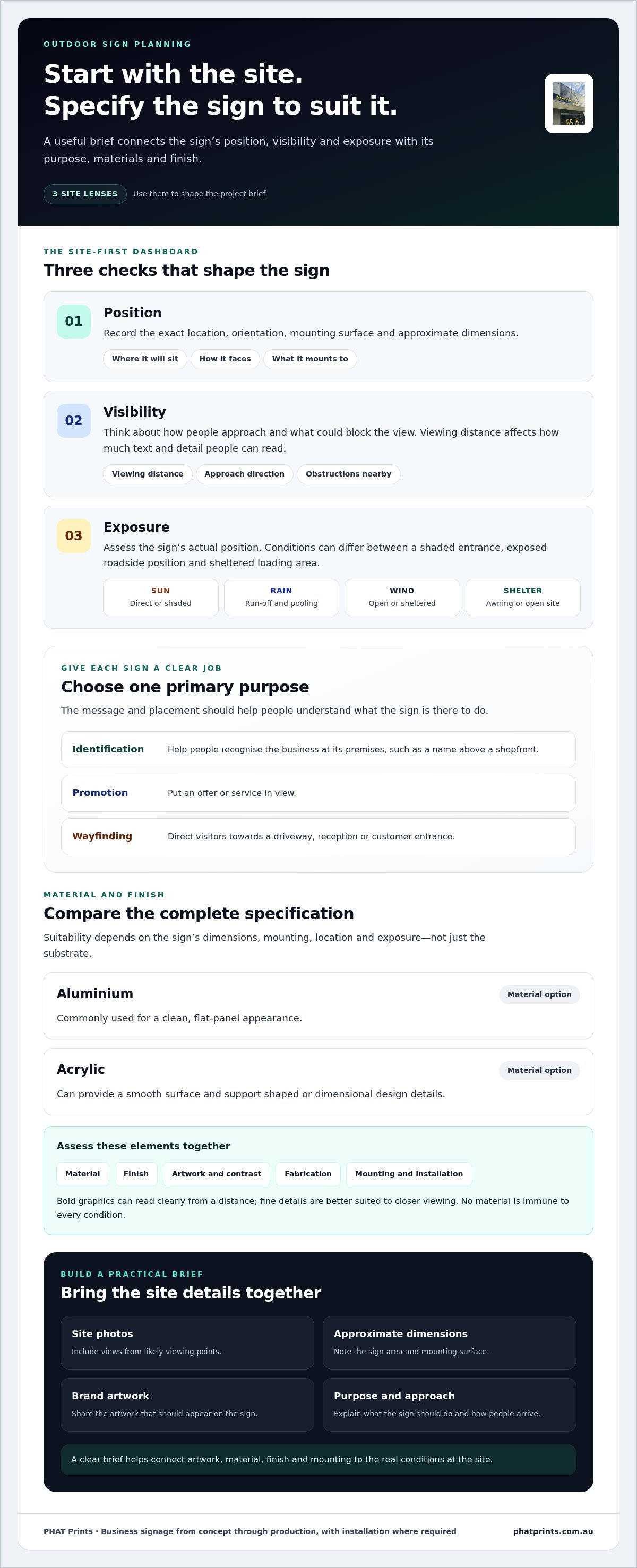
- Position: exact location, orientation and mounting surface.
- Visibility: viewing distance, approach direction and obstructions.
- Exposure: direct sunlight, rain, wind, shade and shelter.
These details give the design a clear job and help shape an outdoor sign that works on site, not just on screen.
How Australian weather influences outdoor sign design and materials
Sun, rain and wind belong in the site brief, not as afterthoughts once the design is finished. For custom outdoor signs, exposure can influence how colours and finishes look over time, where water runs or collects, and what the mounting approach needs to account for. No material is immune to every condition. Performance depends on the substrate, finish, fabrication, sign size, location and installation working together.
How sun, rain and wind affect sign planning
Direct sunlight can affect the appearance of a sign’s colours and finish. Consider how the design will look in bright daylight, and keep the key message distinct from its background. A shaded or sheltered position may face different conditions, but shade can also affect how visible the sign is from the street.
For rain exposure, look at the sign’s position and construction. Check where water runs off nearby roofs or awnings, and whether moisture could collect around the sign. This helps inform placement and the finished build without assuming every outdoor site has the same level of exposure.
Wind matters too, particularly for larger signs or open locations. Size, position, mounting surface and fixing approach are connected, so the site should inform how the sign is specified and installed. A broad, exposed wall and a sheltered entry call for different planning considerations.
How to compare outdoor sign materials and finishes
Compare materials by the look and function the sign needs to deliver. Aluminium is commonly used for a clean, flat-panel appearance, while acrylic can provide a smooth surface and support shaped or dimensional design details. Both can be considered for business signage, but suitability depends on the sign’s dimensions, mounting, location and exposure.
Assess the complete sign, not just the substrate. The finish affects how the surface presents; the artwork affects contrast and readability; and fabrication and installation influence how the finished piece works on site. Bold graphics can read clearly from a distance, while fine details are better suited to closer viewing.
- Start with exposure: note direct sun, rain, wind and available shelter.
- Define the purpose: prioritise visibility, identification or another clear job.
- Assess the full specification: consider material, finish, artwork, fabrication and mounting together.
Choose materials and finishes to suit the site’s exposure, the sign’s purpose and the presentation your brand needs. PHAT Prints creates business signage from concept through production, with installation where required. Explore custom outdoor signage options as you shape your brief.
Compare custom outdoor sign formats for your business location
The right format depends on where people encounter your business and what they need to know. A fixed sign identifies your premises over time; a temporary sign can carry a promotion or event message that changes. Match the format to the site rather than expecting one sign to cover every purpose.
| Format | Common purpose | Site fit | Key planning consideration |
|---|---|---|---|
| Building or fascia sign | Identify a business and support visibility from nearby approaches | Shopfronts and building façades with a suitable sign position | Check sightlines from the direction customers approach and how the sign sits with the façade |
| Freestanding sign | Identify a business or direct visitors to an entrance | Sites where a sign near a driveway or entrance can be seen clearly | Consider viewing distance, obstructions, placement and exposure |
| Banner | Promote a time-limited offer, event or changing message | Locations with an appropriate place to display a temporary message | Keep the message brief and plan for placement and weather exposure |
| Illuminated sign | Support visibility beyond daylight hours | Locations where evening or low-light visibility is important | Assess the viewing angle, surrounding light and site requirements |
Which sign format suits a shopfront, building or site?
A fascia or building sign places the business name where people can connect it with the premises. Its position should work for the street, footpath or car park approach, not just look balanced on the building. For a business set back from the road, a freestanding sign near the driveway may help visitors identify the site earlier, provided there is a clear sightline.
Choose an illuminated format when people need to see the sign beyond daylight hours. Its effectiveness still depends on placement and surrounding light, so consider how it will appear from the intended viewing point.
When do banners or temporary signs make more sense?
Banners suit messages with a defined run, such as an event or promotion, particularly when the information will change. A permanent sign is better suited to ongoing business identification. Avoid combining both jobs in one format if that would crowd the message or make updates impractical.
Use this decision rule: start with the business objective, then weigh up viewing distance, how long the message needs to stay in place and the site’s exposure. A short-term promotion may call for a banner; ongoing identification may call for a building or freestanding sign. The location and conditions determine whether the format is a practical fit.
Plan custom outdoor signs with a practical site and artwork checklist
A clear brief gives your sign project direction from the start. Work through these steps before requesting a quote so the purpose, site conditions and creative assets are ready to shape a practical specification.
- Set the objective. Decide whether the sign needs to identify your business, promote an offer or guide people to a particular area. Put the most important message first.
- Pinpoint the exact site. Record where the sign will go and how people approach it, whether on foot, by vehicle or from a nearby road.
- Capture the surroundings. Take photos of the proposed position, the approach and the wider context. Include visible obstructions, nearby traffic, access constraints and the mounting surface.
- Note dimensions and exposure. Record approximate sign dimensions and whether the position is exposed, sheltered or shaded. Note direct sun, rain and wind, along with any practical access considerations.
- Gather brand assets and message details. Collect current logo files, brand colours, fonts and the final wording. Identify the preferred sign format and intended use.
- Consider local requirements. Sign requirements can vary by location, so check the current requirements for the relevant local council before proceeding with the proposed site and format.
What to measure and photograph before requesting a quote
Photograph the intended mounting position close up and from the direction people will see it. Include enough of the surroundings to show nearby signs, buildings, trees or traffic that may affect visibility. Approximate dimensions are a useful starting point; also note the surface and any visible access or mounting constraints. These details help turn the site into a workable brief.
How artwork and brand details support production
Share your current logo and brand assets, then clarify the message hierarchy: what must stand out first, and what supporting detail can remain secondary? Include your preferred format and whether the sign is for ongoing identification or a temporary message. PHAT Prints accepts artwork uploads through its website, so you can include supplied creative assets with the project details.
For custom outdoor signs, practical site information and clear artwork give the design a stronger starting point. Bring together your objective, site photos, approximate dimensions, exposure notes and brand files, then request a custom signage quote with your project details and artwork.
Bring your custom outdoor sign from concept to installation with PHAT Prints
A strong sign project connects the business goal to the realities of the site. Location and viewing direction help shape the format and design; exposure informs the specification; and brand assets bring the finished sign into line with the wider business identity. Bring these elements together to give the sign a clear purpose from the outset.
PHAT Prints creates custom business signage, including outdoor signs, from concept through production and installation where required. Your brief guides both the design direction and the physical sign, so the artwork is considered in its setting. A sign intended to identify a shopfront, for example, has a different role from one promoting a short-term offer at a site entrance.
What to expect from a tailored signage project
Start with the business objective and intended location. Share the site context, approximate dimensions, viewing direction and exposure, along with the message the sign needs to communicate. These details help shape a design direction that balances brand presentation with practical visibility.
Custom production turns the agreed direction into physical signage. Material, finish, format and artwork are considered as parts of the complete sign, with choices tailored to the project rather than based on a blanket claim about outdoor performance. Where installation is required, the site context also informs how the finished sign becomes part of your business presence.
This joined-up approach connects the sign’s appearance with its purpose and gives the project a clear pathway, from initial brief and artwork through production and, where required, installation.
Turn your outdoor signage brief into action
Bring together the essentials: your business location, the sign’s purpose, preferred format, approximate dimensions and relevant site photos. Add brand artwork and explain how people will approach or view the sign. If the creative is still taking shape, share the brand assets and project requirements you have so far.
PHAT Prints provides website options to request a quote and upload artwork, making it straightforward to bring project details together. A clear brief describing the site and the sign’s purpose gives the project a stronger starting point.
Ready to give your business a clearer presence outdoors? Request a custom signage quote and upload your artwork to start your custom sign project.
Put your outdoor sign plan into motion
Effective custom outdoor signs start with the site and the job they need to do. Consider how people approach, what they need to see and how exposure to sun, rain and wind may shape the sign’s design and specification. Then choose a format that suits the location and whether the message is permanent or temporary.
A clear brief brings those decisions together: share the sign’s purpose, site details, preferred format and brand artwork. PHAT Prints creates custom business signage from concept through production, with installation where required. You can request a quote and upload artwork through the website.
Ready to build a distinctive presence for your business? Start your custom outdoor sign project with PHAT Prints and turn your brief into a clear next step.
Frequently Asked Questions
What material is best for custom outdoor signs?
There isn’t one best material for every sign; the right choice depends on the site, sign purpose, size, mounting and desired presentation. Aluminium can suit a clean, flat-panel look, while acrylic offers a smooth finish and options for shaped or dimensional details. For custom outdoor signs, consider the material alongside the finish, artwork and installation context. PHAT Prints tailors business signage to the project brief rather than relying on a universal material recommendation.
How do I make an outdoor sign last in Australian weather?
Plan the sign around its actual exposure and consider the whole specification together. Note direct sun, rain run-off, wind, available shelter, sign size and mounting surface. Material, finish, fabrication and installation can all influence how the sign performs and looks over time, so avoid assuming one material or finish suits every Victorian site. Clear artwork and suitable placement also help keep the message visible as conditions change.
Do I need council approval for an outdoor business sign in Victoria?
Approval requirements can vary between Victorian councils and depend on the sign’s location and details, so don’t assume one rule applies across the state. Before ordering or installing a sign, check the current requirements with the council responsible for the site. Include the proposed position, dimensions, format and whether it will be illuminated when reviewing the project. This helps you plan the sign around the location’s requirements from the start.
What information should I provide for a custom outdoor sign quote?
Share the sign’s purpose, business location, preferred format and approximate dimensions. Add photos of the proposed position and its approach, plus notes on the mounting surface, visibility, exposure and any access constraints. Include your key message and brand artwork if available. These details give PHAT Prints a clearer picture of the project and help shape a tailored signage brief. You can request a quote and upload artwork through the website.
Are illuminated outdoor signs suitable for every business?
No. An illuminated sign is worth considering if customers need to see your business beyond daylight hours, but it may not suit every site or objective. Think about viewing direction, surrounding light, placement and how illumination fits the brand presentation. The sign’s format should also work within the site’s requirements. For a business that mainly needs clear daytime identification, a non-illuminated format may better match the purpose.
Can I use the same outdoor sign design across multiple locations?
Yes, a consistent core design can help customers recognise your brand across locations, but each sign should still suit its site. Differences in building frontage, viewing distance, approach direction, exposure and available space may call for adjustments to dimensions, layout or format. Keep the key brand elements consistent, then tailor the practical specification for each position. For multiple Victorian sites, consider each location on its own rather than assuming one setup fits all.
How should I prepare artwork for custom outdoor signs?
Gather your current logo, brand colours, fonts and final wording, then decide which message should stand out first. Consider viewing distance when judging how much detail to include; fine text may be difficult to read from further away. Provide the artwork with your preferred format, intended use, site photos and approximate dimensions. PHAT Prints accepts artwork uploads through its website, so you can include creative assets with your project details when requesting a quote.
